
Learning hub · Families
A dash cam for a teen driver: what it gives the family
The first months of driving alone carry the highest crash risk of a young driver's life, and the parent is no longer in the passenger seat. Here is what a dash cam does for a family in that year — and what the research says about the teen behind the wheel.

The first ninety days are the whole game
A newly licensed teenager is not a slightly less experienced adult. Per mile driven, the fatal crash rate for 16- to 19-year-olds is just over three times that of drivers 20 and older, according to the Insurance Institute for Highway Safety's 2024 fatality data, and the risk is highest at 16 and 17.
The sharpest jump is right at the handover. A National Institutes of Health study that put cameras and sensors in the cars of 90 Virginia teens found they were eight times more likely to crash or nearly crash in the first three months after getting their license than in the three months before it, while still driving supervised on a permit.
That is the gap a dash cam sits in. IIHS recommends 70 hours of supervised practice before a teenager drives alone. After that, the parent gets out of the car and the record of every drive stops — unless something in the car keeps one.
It is the passengers, not just the phone
Ask a parent what worries them and the answer is usually the phone. The research points somewhere less obvious: other teenagers in the car. In the AAA Foundation's video study of real teen crashes, interacting with passengers was the single most common distraction — ahead of the phone.
Graduated licensing laws exist in every state for exactly this reason, and many restrict passengers or night hours in the first year. What the rules cannot do is tell you whether they were followed on Friday night.
| Risk | What the research found | Source |
|---|---|---|
| Passengers | One passenger roughly doubles a 16- or 17-year-old's risk of dying in a crash; several teen passengers raise it as much as sevenfold | National Safety Council, Injury Facts, citing AAA Foundation research |
| Distraction | 59% of teen crashes showed a distracting behavior in the six seconds before impact. Passengers accounted for 15% of crashes, phones for 12% | AAA Foundation for Traffic Safety, naturalistic video study of 2,229 teen crashes, 2016 |
| Night driving | 16- and 17-year-olds take about 10% of their trips between 9 p.m. and midnight, but 19% of their fatal crashes happen then | National Safety Council, Injury Facts, citing NHTSA 2024 data |
Figures are for the US and are published by the sources named. None of them is changed by a camera; a camera only makes the record honest. What each camera channel actually sees is in single vs dual vs triple.
What the cabin channel actually does
It does not stop a teenager from carrying three friends at 11 p.m. It means that a family agreement about passengers and hours is something both sides can check, rather than something one side has to take on trust. The footage is for the day something happens; most days, nobody needs to open it.
Video changes how teens drive — when parents look
The most direct evidence comes from a University of Iowa study published in the Journal of Safety Research in 2007. Twenty-six rural 16- and 17-year-olds drove with an event-triggered camera, and their parents reviewed the clips with them each week. Over 18 weeks, safety-relevant events fell from 8.6 to 2.1 per 1,000 miles — a 76% drop — and seat-belt use rose from 82% to 97%. Among the highest-risk teens the drop was 89%.
American Family Insurance, which ran a similar camera-and-feedback program for its policyholders' families, reports a 70% reduction in risky driving behavior across more than 10,000 participants. That is the insurer's own figure, not an independent one.
Read those results carefully. They came from programs where a parent sat down with the footage every week. The camera recorded; the conversation did the work. A camera nobody talks about changes nothing. A camera the family talks about does.
Should you put a dash cam in your teenager's car?
Yes — and tell them. A camera a teenager discovers is surveillance. A camera a teenager was handed the box for is protection, and the difference decides whether it works.
The pitch that lands is the one that is true: an inexperienced driver is easy to blame when two accounts disagree, and the footage is on their side as much as yours. Consumer Reports' 2026 dash cam guide makes the same point from the parent's chair — a camera lets you see where a young driver went — but it is the teenager's protection that they will remember.
Then set the terms out loud. Nobody watches footage unless something happens or the agreement is broken. Audio can be switched off, and should be if their friends would rather not be recorded. Roughly a dozen states require everyone in a conversation to consent to being recorded, according to the Reporters Committee for Freedom of the Press; video of your own car is not the problem, but a passenger's voice can be.
One camera. Whoever is driving.
Front, rear and cabin recorded together, with GPS stamping location and time on the footage. Nothing to hand over when the keys change hands — the record is already in the car.
4K front, 1080p rear and cabin · Sony STARVIS night vision · GPS antenna, hardwire kit and 64GB high-endurance card included · audio can be switched off · 18-month warranty · $199.90
See the LYNX Guardian 36018-month warranty · free US shipping · 30-day free returns
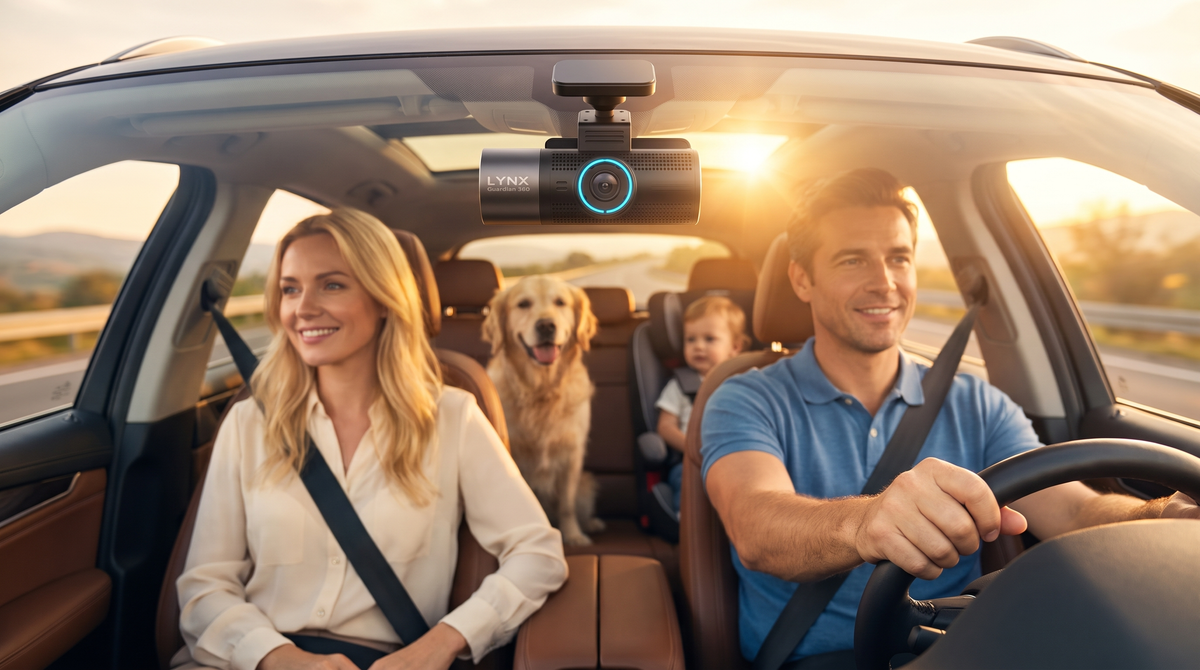
The family car: road trips, grandparents and the school run
The teen driver is the sharpest case, but a family car spends most of its life doing something quieter: the school run, a grandparent picking up from practice, six hundred miles to the coast in July. A record-setting 61.4 million Americans drove for the Fourth of July in 2026, according to AAA.
None of that is a reason to doubt whoever is driving. A 2011 study in the journal Pediatrics found children were roughly half as likely to be injured in a crash when a grandparent was at the wheel rather than a parent. The camera is not there for the driver you trust. It is there for the driver who hits the car carrying your kids, far from home, and then disagrees about what happened.
Increasingly, they leave. The AAA Foundation for Traffic Safety counted 919,292 hit-and-run crashes in the US in 2023 — 15% of all police-reported crashes and the highest share on record — and found that 40% of the fleeing drivers it could identify had no valid license. With a camera, a hit-and-run is a clip with a time and a location. Without one, it is a phone call to your insurer with nothing attached.
What it will not do for your premium
No major US insurer offers a discount for owning a dash cam — the comparison site The Zebra confirmed as much again in January 2026, and AAA says the same. The programs that do lower a teen's premium are the insurers' own telematics apps and young-driver courses, which track the driving rather than record it.
Footage shows what happened, which is what a fault decision turns on. Two contradicting accounts and no video can leave a claim split, and a young driver carrying a crash that was not theirs. For a family adding a 17-year-old to a policy, that difference matters more than any discount.
Parking mode covers the car when it is left on a street or in a lot; the hardwire kit that powers it is included with the LYNX Guardian 360. How the modes differ, and what they do to a battery, is in parking mode explained. Which specifications matter when you compare cameras is in best dash cam 2026.
For parents
Questions worth asking.
Is it legal to record my own teenager in the car?
Video in your own vehicle is not the issue. Audio is: roughly a dozen states require everyone in a conversation to consent to being recorded, according to the Reporters Committee for Freedom of the Press, and that applies to your teenager's friends. Tell your teen the camera is there, and switch audio off in the settings if you are unsure. We are not lawyers; if you need certainty for your state, ask one.
Won't my teenager just see it as spying?
Some will, at first. The approach that holds up is to treat the camera as the teenager's protection — the impartial account when an inexperienced driver is blamed — and agree in advance that footage is only looked at after an incident or a broken rule. The University of Iowa program that cut risky events by 76% relied on that weekly, open conversation, not on secret monitoring.
Does it record where and when?
Yes. The GPS antenna included with the LYNX Guardian 360 stamps location, time and speed on the footage, so a clip shows where the car was, when it happened and how fast it was moving. That record cuts both ways, which is exactly why it is credible.
Will a dash cam lower my teen's insurance?
Not directly — no major US insurer offers a dash cam discount as of early 2026. Insurers' own telematics programs and young-driver courses do offer discounts; ask yours. Footage helps in a different way: it shows what happened, which is what a fault decision turns on.
Do I need the hardwire kit?
Only for parking mode — recording while the car is parked and the ignition is off. Plugged into the 12V socket, the camera records every drive with about ten minutes of setup and no tools beyond the trim tool in the box. The hardwire kit is included with the LYNX Guardian 360; many owners fit it themselves with the instructions in the box, and if you would rather not, an auto-electrician will do it in under an hour. Our installation guide walks through both.
Still unsure? Email support@auradrivetech.com and we'll reply within one business day.
Keep reading
- Best dash cam for a car in 2026Six specifications worth checking, in order of how much they matter.
- Single vs Dual vs TripleWhat each system sees, and when the cabin channel earns its place.
- Dash cam parking mode explainedWhat happens after the engine stops, and what it costs your battery.
- The Learning HubEvery guide in one place — recording, storage, night vision and fitting.
 LYNX Guardian 360Triple-channel. 4K front, 1080p rear and cabin. GPS, hardwire kit and 64GB card included. $199.90
Ready when you are
Know they got home. See the drive.
4K front, 1080p rear and cabin. GPS, hardwire kit and 64GB card in the box.
18-month warranty · free US shipping · 30-day free returns