
Learning hub · Coverage
Single vs Dual vs Triple: which dash cam is right in 2026?
One camera watches the road ahead. Three watch what actually happens around your car. Here is what changes as you add channels — and the thing most three-channel boxes do not tell you.

Why the number of cameras changes everything
Every dash cam records the road ahead. What separates a single, dual and triple system is everything outside that cone — behind you in traffic, and inside the cabin when you are carrying passengers.
Plenty of disputes never involve the front of the car at all: rear-end contact, lane merges, and parking-lot damage where the other driver's account is the only account. Often there is not even that — the AAA Foundation for Traffic Safety counted, in its March 2026 report, 919,292 hit-and-run crashes in the US in 2023 — 15% of all police-reported crashes and the highest share on record.
What each system actually covers
These are three product types, not three shopping baskets — every one of them is a single connected system. The practical question is not how many cameras you can fit. It is which angle you would regret not having. If you are still working out what matters before you compare models, start with what defines a good dash cam in 2026.
| System | Cameras | What it sees | Best for |
|---|---|---|---|
| Single | One, front | The road ahead | Basic forward recording |
| Dual | Two, front and rear | Ahead and behind | Everyday driving |
| Triple | Three, front, rear and cabin | Ahead, behind and inside | Rideshare, fleet, carrying passengers |
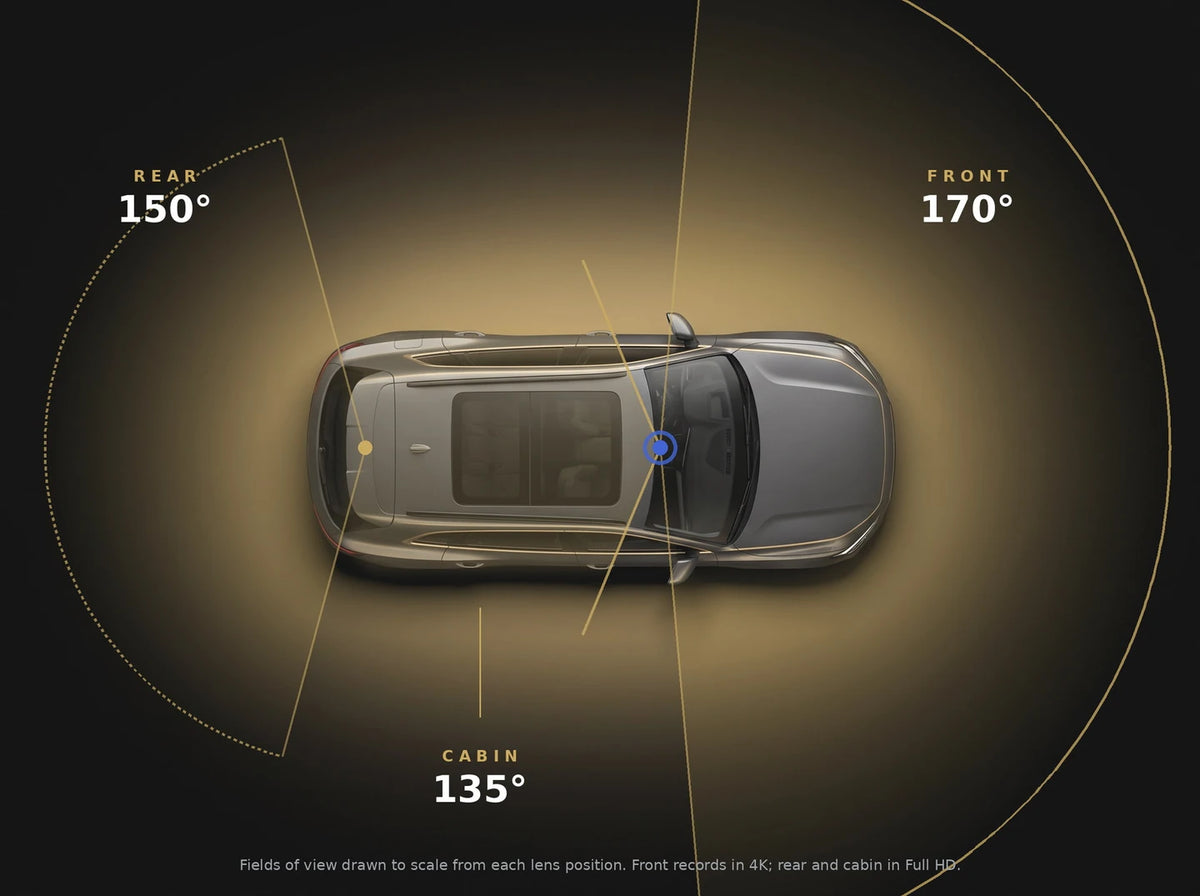
Categories, not brands — every manufacturer sets its own fields of view. The LYNX Guardian 360 is a triple system: 170° front, 150° rear, 135° cabin, quoted diagonally as the industry quotes them.
Whichever you choose
Check what actually comes in the box, and what happens if it fails. Parking mode does not necessarily mean the hardwire kit is included, and a warranty and a return window matter more than any line on a spec sheet.
Where cars actually get hit
The case for a second and third camera is not that more is better. It is where the damage tends to come from. According to NHTSA's Traffic Safety Facts, rear-end collisions make up roughly 29% of all US crashes — close to a third of everything that happens on the road happens behind you, in the one place a single-channel camera cannot see.
The cabin camera is more specific. Consumer Reports' dash cam buying guide puts it plainly: an interior camera is worth having if you drive for Uber or Lyft, or if a teen driver uses the car. Everyone else can reasonably skip it.
One more number worth sitting with. In a 2025 survey of 1,000 US drivers by the Marc Brown Law Firm, 39% of dash cam owners said they bought one after an accident or a close call, and one in five had already used footage for an insurance claim. Most people decide how many cameras they need after the day they needed them. This page exists so you can decide before.
The cost nobody puts on the box
Here is a pattern worth knowing before you compare three-channel prices. We checked what ships in the box across the main three-channel cameras sold in the US as of August 2026: most advertise parking mode, and few include the hardwire kit that parking mode requires. It is usually a separate purchase, typically around $30.
Memory cards go the same way. Some brands include one; many do not, and a decent 64GB high-endurance card is another $15 to $20.
So a $280 camera with parking mode advertised on the box is a $310 to $330 camera by the time it does the thing on the box. Worth adding up before comparing to anything, including us.
Coverage does not stop when the engine does
Parking mode is where a rear and cabin channel earn their place. A car left overnight is hit from behind, scraped along the side, or broken into — and a forward-facing camera sees none of it.
How a camera watches while parked varies. Impact detection locks a clip the moment the car is struck. Motion detection wakes the camera when something moves in frame. Time-lapse records continuously at a reduced frame rate. Published power figures for these modes are hard to compare across brands, so what actually protects your battery is the low-voltage cutoff in the hardwire kit, not the mode you pick.
How parking mode works in practice is worth ten minutes if you park on the street.
What adding channels costs you
More channels means more data per hour, so the card fills sooner and gets rewritten more often. A dash cam writes and overwrites high-resolution video loop after loop, day after day, and an ordinary card is built for occasional writes rather than that kind of constant rewriting — which is why cards are the most common point of failure in any dash cam.
High-endurance cards are rated for it explicitly: Samsung publishes 35,040 recording hours for its 64GB PRO Endurance card, and SanDisk quotes up to 40,000 hours across its High Endurance line. Standard cards carry no endurance rating at all, which is the actual difference — not a multiplier, an absence.
Loop recording handles the space. Card endurance handles the wear. The LYNX Guardian 360 ships with a 64GB high-endurance card and takes up to 256GB.
Three angles, one clock, one box.
Front, rear and cabin recorded together on a single timeline. Continuous while you drive; impact, motion or time-lapse while you are parked.
4K front, held with all three channels running · 1080p rear · 1080p cabin · 170° / 150° / 135° diagonal · Sony STARVIS with front-channel HDR · hardwire kit, GPS antenna and 64GB high-endurance card included · $199.90
See the LYNX Guardian 36018-month warranty · free US shipping · 30-day free returns
What three cameras still cannot see
Three channels cover the front, the rear and the cabin. There is no side-facing lens, so a strike directly to either side sits outside all three fields of view.
Every three-camera system shares that limit — it is a property of pointing three lenses, not a shortcoming of any one product. Four-channel systems have started appearing for exactly this reason, and if side coverage is your specific worry, that is the category to look at rather than a wider front lens.
Before you choose
Questions worth asking.
Is a triple-channel dash cam worth it over a dual?
It depends on who is in the car. If you drive alone, the cabin channel adds little and a dual system covers the two angles that matter. If you carry passengers — rideshare, family, a work vehicle — the cabin channel is the one that settles disputes about what happened inside the car.
What resolution does each channel record?
On the LYNX Guardian 360 the front channel records 4K, and it stays 4K with all three channels running rather than only when the others are switched off. Rear and cabin record 1080p. That distinction is worth checking on anything you compare: several well-known cameras drop the front channel to 1440p, or to 24 frames per second, once all three channels are recording.
I drive for Uber. Does the cabin camera actually help?
It is the reason most rideshare drivers move from a dual to a triple. A cabin channel records what was said and done inside the car, which is what a disputed passenger complaint turns on. Audio can be switched off in settings, and some states require every party to consent to being recorded — worth checking the rules where you drive.
Do I need a hardwire kit for parking mode?
Yes. Parking mode needs power after the ignition is off, which means wiring into the fuse box. The kit is included with the LYNX Guardian 360 — worth checking on anything you compare, because parking mode does not necessarily mean the kit is included, and it is usually sold separately. Many owners fit it themselves with the instructions in the box; if you would rather not, an auto-electrician will do it in under an hour. Our installation guide walks through both.
Will three channels fill the memory card faster?
Yes, which is why loop recording exists. The oldest footage is written over as the card fills, and clips locked by the G-sensor are kept. A 64GB high-endurance card is included, and the camera takes up to 256GB.
Still unsure? Email support@auradrivetech.com and we'll reply within one business day.
Keep reading
- Best dash cam for a car in 2026Why coverage architecture matters more than a resolution number on the box.
- Dash cam parking mode explainedWhat happens after the engine stops, and what it costs your battery.
- A dash cam for a teen driverWhat the first months of driving alone look like in the research, and how to introduce a camera as protection rather than surveillance.
- The Learning HubEvery guide in one place — recording, storage, night vision and fitting.
 LYNX Guardian 360Triple-channel. 4K front, 1080p rear and cabin. Hardwire kit and 64GB card included. $199.90
Ready when you are
Three cameras. One decision.
4K front, 1080p rear, 1080p cabin. Hardwire kit and 64GB card in the box.
18-month warranty · free US shipping · 30-day free returns